Follow potential routes through water, soil, air, food webs, and waste systems.
Follow a possible pathway
These are conceptual pathways, not a map or a finding that a particular site is contaminated. Every step can require its own measurements.
Water and groundwater
Release or leaching
Surface water or groundwater
Drinking water or aquatic food web
A release reaches a stream, river, lake, or groundwater. Water can carry some PFAS away from the release location. Movement depends on the chemical, soil, water flow, and the history of the site.
Potential human contact includes drinking contaminated water or eating fish from affected waters. A sample from a river does not automatically describe finished tap water.
Soil, crops, and food
Deposition or land application
Soil and soil water
Crops, livestock, or groundwater
Deposition, spills, or contaminated biosolids can introduce PFAS to soil. Some molecules attach to soil and organic matter; others move into pore water or groundwater. Plants can take up certain PFAS.
The concentration in a crop or animal is not determined by the soil result alone. Uptake depends on the substance, species, tissue, and growing or feeding conditions.
Air and deposition
Airborne emission
Transport and deposition
Soil, surface water, or inhalation
Manufacturing emissions, particles, and some volatile precursor substances can move through air. Deposition transfers material from air to land or water; a precursor can also change into a different PFAS.
A nearby facility is a potential source, not proof of a particular person’s exposure. Air, deposition, soil, and water measurements provide different parts of the account.
Waste and recirculation
Discarded material or wastewater
Treatment, disposal, or reuse
Effluent, biosolids, leachate, or used media
Products, industrial residues, landfill leachate, wastewater, and treatment media can move PFAS between waste systems. Wastewater treatment or filtration may transfer PFAS rather than destroy them.
Following a waste stream requires records of where the material was generated, treated, transported, and placed. A single sample cannot reconstruct the full pathway.
A pathway connects a source with a possible receptor
A source is a place or material from which a chemical is released. A pathway is the route it can travel. A receptor is a person, animal, plant, or environmental feature that can encounter it. Those parts need to connect before a potential source becomes evidence of a particular exposure. [1][2]
Movement and transformation are different processes
Transport moves a substance from one place to another. Sorption attaches it to a surface. Transformation changes one chemical into another, which may still be a persistent PFAS. A change in the mixture can therefore occur without eliminating the fluorinated material. Water flow, soil properties, biological activity, and chemical structure influence the pattern. [1][2]
The end of one process can be the start of another
A wastewater plant, drinking water filter, or landfill can transfer PFAS between streams or materials. Capturing a substance can reduce its concentration in treated water while leaving a used medium or concentrated waste that needs management. Following the material through that next step is part of understanding the full environmental account. [3][2]
See the work
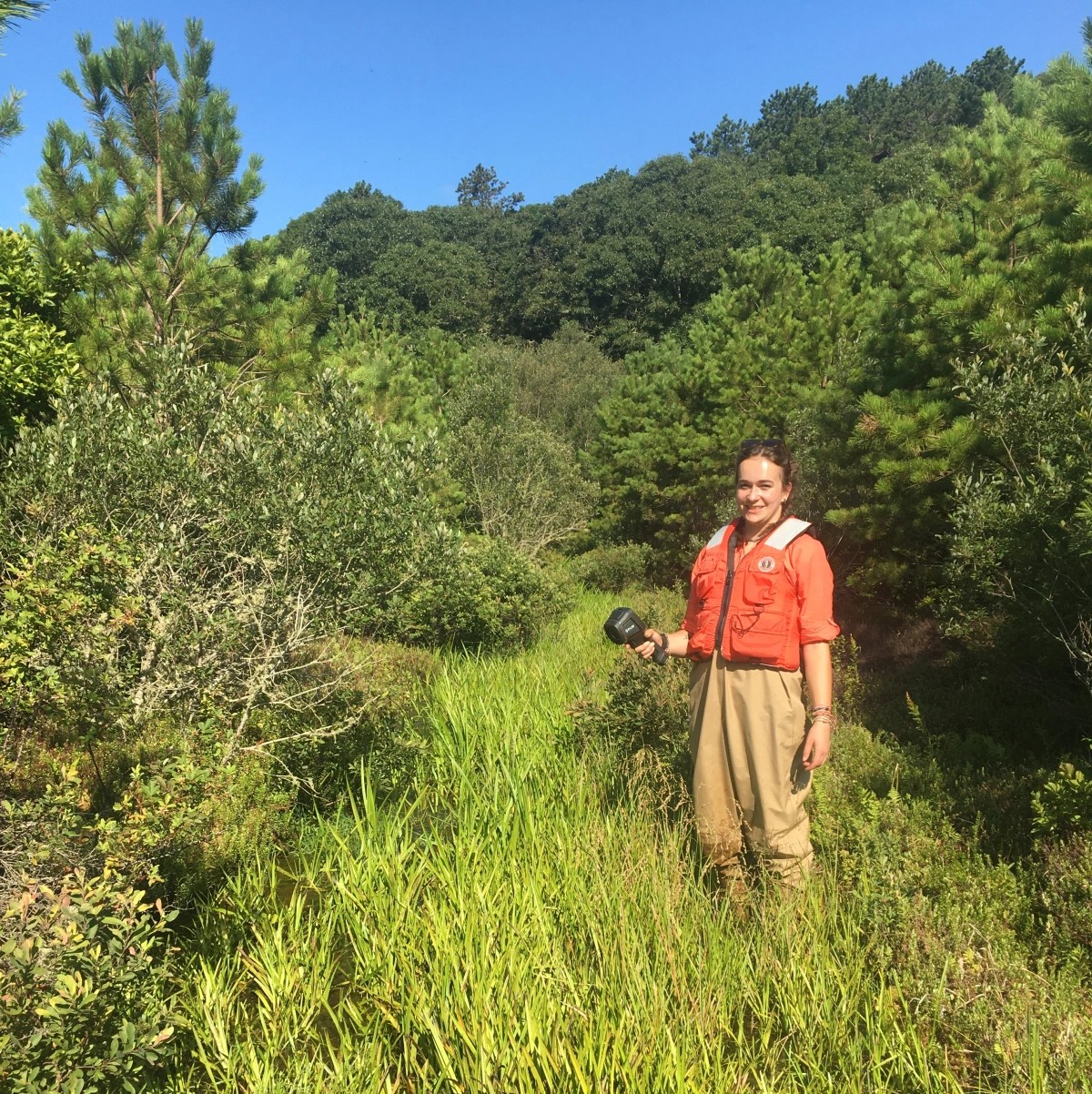
Finding groundwater seeps on Cape Cod
USGS hydrologist Hayley Lind uses an infrared camera to locate groundwater entering a former cranberry bog on Cape Cod, Massachusetts, as part of a study of groundwater seepage and PFAS occurrence.
Photo: Denis LeBlanc, U.S. Geological Survey · Public domain