PFAS is a chemical class, not one substance. The OECD definition and classification framework encompass a much larger universe than any routine targeted panel measures. A laboratory result described as total PFAS therefore needs a definition. It may mean the sum of a specified list, rather than every PFAS present.
Ask which chemicals the method seeks, which material it analyzes, how the sample is prepared, and what the result’s units represent. These questions reveal the boundaries of a measurement before the number is interpreted. The word total cannot remove those boundaries. [1]
A targeted sum needs its ingredient list
Targeted analysis looks for specified chemicals using their analytical signatures and suitable standards. A sum combines results for a defined set of those chemicals. It does not identify substances that were never included.
Hypothetical example: a panel reports PFOA at 3 ng/L, PFOS at 2 ng/L, and PFHxS below 1 ng/L. Adding quantified results gives 5 ng/L for the two reported detections. It does not prove the sample contains exactly 5 ng/L of all PFAS. The third value is bounded by the reporting convention, and other substances remain outside the panel. Different rules for handling nondetects can also produce different sums from the same table. [1]
What the TOP assay does
The total oxidizable precursor assay, usually called TOP, compares targeted results before and after strong laboratory oxidation. Some precursors become perfluoroalkyl carboxylic acids that the target method can measure. An increase after oxidation can reveal material that the original analysis did not identify directly.
The freely accessible review of TOP methods explains why laboratory conditions and the product list matter. Some compounds may not convert under the chosen conditions. Others can produce substances outside the final panel. TOP is a useful addition to targeted testing, rather than a complete count of every PFAS or a simulation of the time needed for changes in a river. [2]
Why TOP is not a universal PFAS total
TOP does not recover every possible precursor or convert every fluorinated substance into the same measurable products. Oxidation conditions, sample composition, compound structure, and the compounds measured afterward affect the result. Polymeric materials and products outside the analytical panel can remain poorly represented.
Hypothetical example: measured acids increase from 5 to 12 ng/L after oxidation. The 7 ng/L difference describes those reported products under that procedure. It is not automatically 7 ng/L of the original precursor molecules. Transformation changes molecular identities and masses. Researchers may use molar accounting, recovery checks, and additional methods to interpret the difference. [2]
Fluorine measurements look through another window
Total fluorine includes organic and inorganic fluorine, so fluoride or fluorine bearing minerals may contribute. Extractable organic fluorine, or EOF, measures organic fluorine recovered by a particular extraction procedure. Adsorbable organic fluorine, or AOF, measures organic fluorine retained through an adsorption procedure. Combustion ion chromatography can then measure the resulting fluoride.
These measurements usually report fluorine mass, not the mass of identified PFAS molecules. They can include other organofluorine compounds and miss substances that the preparation does not recover. Their labels describe operationally defined measurements, not a list of chemical identities. [3]
A fluorine mass balance compares compatible quantities
A fluorine mass balance compares measurements expressed on a common fluorine basis. Hypothetical example: an extract contains 100 nanograms of extractable organic fluorine per liter, while identified targets account for 30 nanograms of fluorine per liter. The difference is 70 nanograms of unexplained extractable organic fluorine per liter under those methods.
That difference is not a measurement of 70 nanograms of one unknown PFAS. Compounds have different amounts of fluorine relative to their molecular mass. Extraction, recovery, and the substances covered by each method can also differ. The comparison needs those details before it can support a claim about how much material remains unidentified. [4]
Discovery methods add information
A targeted test looks for a specified list of chemicals. Methods that investigate a wider range of molecular signals can help researchers ask what else might be present. High resolution mass spectrometry can support investigations of suspected or unfamiliar compounds, while complementary fluorine measurements can provide a broader chemical accounting.
These measurements answer different questions. Finding a signal, proposing a chemical identity, and confirming the amount of a named compound are separate steps. Researchers compare evidence such as molecular mass, fragmentation, and reference materials. A clear report states how confident the identification is, rather than presenting every proposed match as an equally certain result. [4][5]
See the work
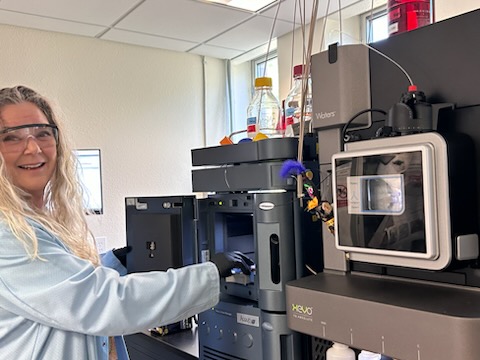
PFAS analysis in a USGS laboratory
A USGS scientist works on PFAS analysis beside a high resolution mass spectrometer. Laboratory instruments help researchers identify and measure chemicals in collected samples.