A water sample measures conditions at collection. Tissue reflects uptake and elimination over an organism’s life. Comparing the two requires attention to the species, tissue, season and chemicals measured. Edible muscle, liver, blood and whole body samples answer different questions.
In a 2025 Great Bay Estuary study, researchers collected water, sediment and shellfish in New Hampshire. Shorter chain compounds were prominent in water, while longer chain compounds were more prominent in sediment and shellfish. The results show why one sample type cannot describe an entire ecosystem. [3]
Accumulation and the food web
Bioaccumulation means uptake from water, food and other surroundings over time. Biomagnification means increasing concentrations along feeding relationships. A predator can receive PFAS from prey, but its tissue concentration also depends on how quickly its body eliminates each chemical.
PFAS do not all behave alike. Long chain acids often accumulate more strongly in animals, and protein binding helps explain why their distribution differs from contaminants mainly stored in fat. A high predator result alone does not establish the rate of increase through a food web; researchers need linked measurements and information about what animals eat. [4][5]
From a research result to a meal decision
The Great Bay researchers also estimated exposure from harvesting and eating shellfish. Eating the catch was the largest modeled route for adults, while contact with sediment contributed relatively more for children. These were estimates built from samples and stated assumptions about harvesting, consumption and absorption, not measured doses in individual harvesters.
The study sampled one estuary during a particular period. Its authors identified limits involving seasonal changes, species availability and chemical mixtures. A research result can identify a concern without being an official meal advisory for every beach, river or species. [3]
What the Michigan deer investigation found
Michigan issued a deer consumption advisory around Clark’s Marsh near Oscoda in 2018 after a deer tested high for PFOS in muscle. Additional sampling clarified the geographic pattern. In July 2021, the advisory area was reduced from five miles to three miles. Guidance available in October 2026 continues to identify that three mile area.
Other sampled Michigan locations had no PFAS or low levels in deer muscle. A local advisory describes a defined area, not all deer. [1]
Reading a fish advisory
A consumption advisory is guidance about eating a particular food, often organized by waterbody, species, fish size and meal frequency. It is not interchangeable with a drinking water limit. Michigan tests fish for PFAS as well as other contaminants and publishes regional eating guides, with emergency updates when needed. The instructions include serving sizes, because a meal is an amount of food rather than simply an occasion.
The relevant guide must match the catch location and fish. A restriction for one species or lake cannot automatically be transferred to every nearby waterbody, and a lack of listed guidance does not document that all possible contaminants were tested. [2]
Appearance and cooking cannot answer the question
A healthy looking animal can contain PFAS. Michigan explains that ordinary cooking cannot remove PFAS from contaminated meat or organs. Its statewide advice against eating wild game organs is separate from the Clark’s Marsh advisory against eating deer within the specified area.
Uncertainty remains about exposure across species and individual animals. Testing selected chemicals in tissue does not automatically establish meal advice. Neither an animal’s appearance nor the water’s clarity supplies that assessment. [1]
See the work
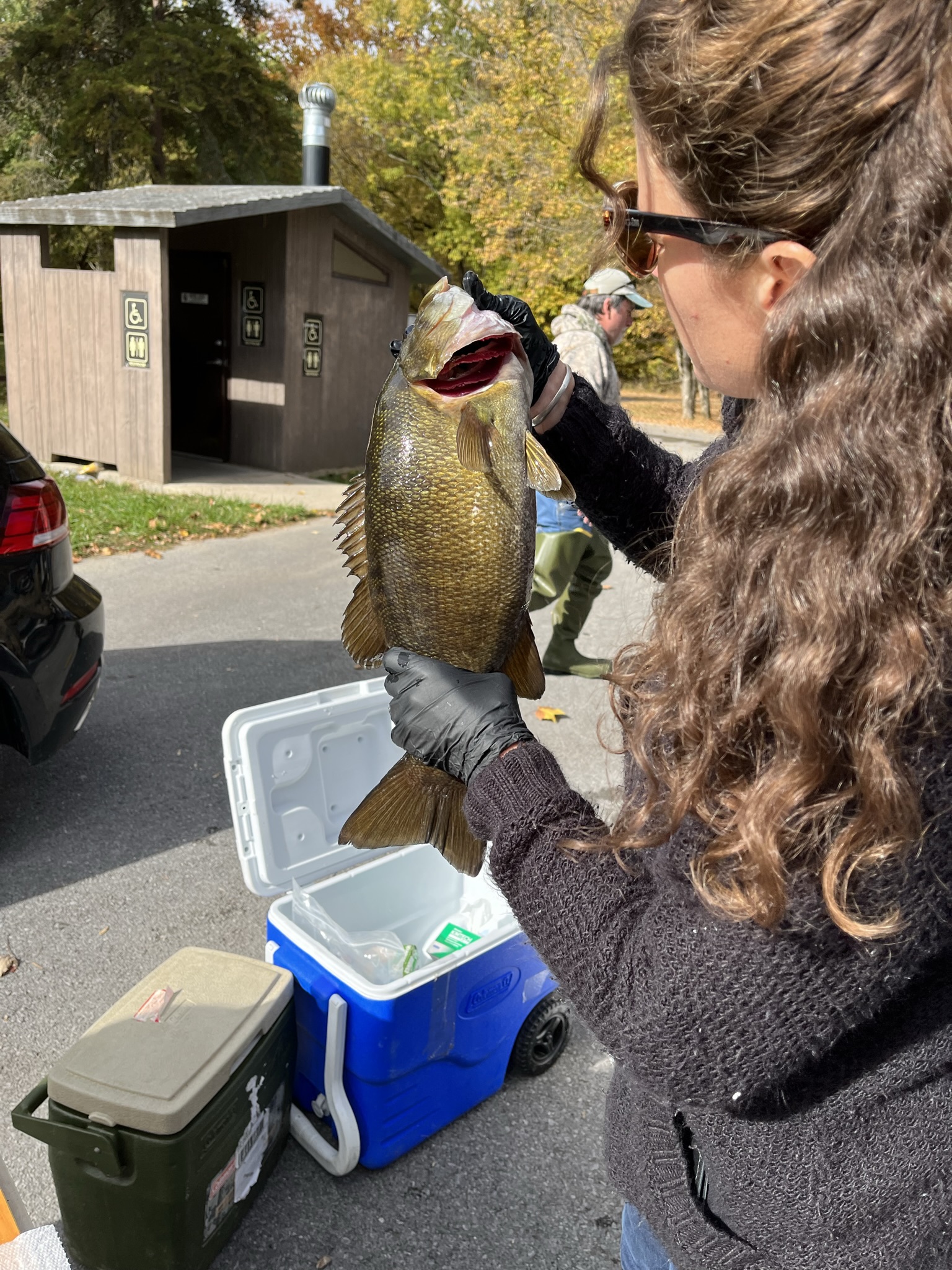
Examining a smallmouth bass during field research
A USGS scientist examines a smallmouth bass as part of nonlethal sampling in the upper Potomac River. The field work combines a health assessment with blood and plasma analysis.
Photo: USGS Eastern Ecological Science Center · Public domain
Follow research developed with the Voigt Intertribal Task Force about PFAS in water and culturally important harvested foods in the ceded territories of Wisconsin, Michigan, and Minnesota.
Wisconsin Sea Grant and Wisconsin Water Resources Institute · Bonnie Willison
English captions are available in the original player.
Investigating forever chemicals in Montana fish
An original Montana investigation into fish tissue testing, public access to results, and the people who rely on local catch. Reporting includes Fort Peck and Flathead perspectives.