A sample is collected to answer a question about a particular material, place, and time. Testing a household well, investigating a field, evaluating a biosolids load, and studying fish tissue require different plans. The laboratory needs to know the material it will receive and the intended use of the result.
Before collecting anything, discuss the method, containers, preservation, shipping, reporting limits, and chemical list with the receiving laboratory. An ordinary soil fertility test is not a PFAS analysis. A laboratory that measures some environmental materials may not offer the method or certification needed for another purpose. [1][3]
Separate soil, groundwater, crops, and amendments
A field can contain several connected sampling targets. Soil describes solid material at the sampled depth. Groundwater describes water below ground, while soil water occupies spaces between soil particles. A crop sample measures plant material. Biosolids or compost samples describe the applied material rather than the entire receiving field.
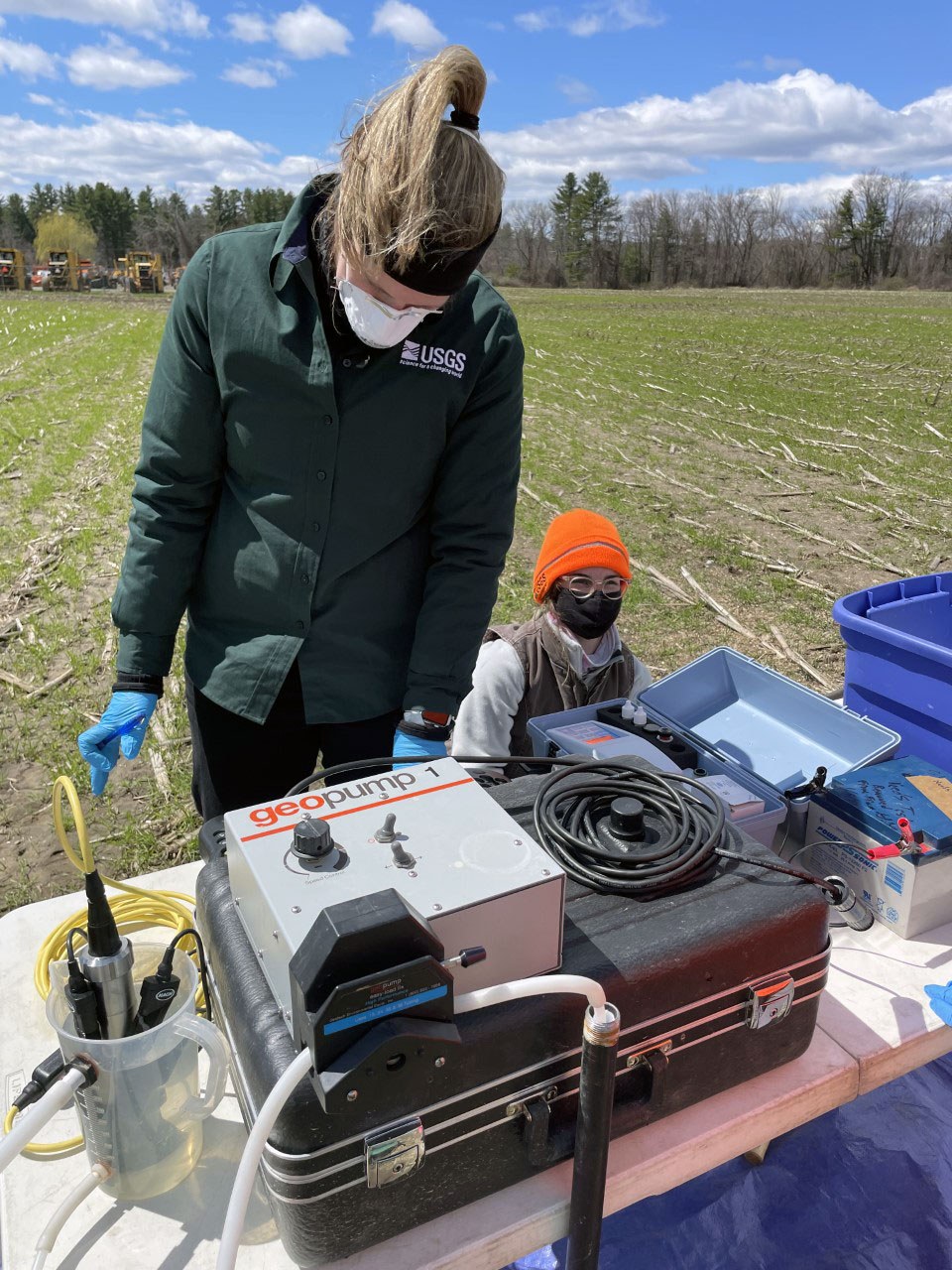
The photograph below shows groundwater sampling near the top of the water table in a New Hampshire corn field. It makes the distinction visible: researchers are collecting water beneath a field, rather than establishing the concentration in corn from the appearance of the plants. [2][1]
Choose locations and depths deliberately
A conceptual site model connects suspected sources with movement and potential exposure. Historical land application records, drainage, groundwater direction, and the intended land use help identify where samples could be most informative. Different soil depths can describe different parts of a contamination pattern.
A sample collected from one convenient spot cannot automatically represent a whole farm or watershed. Recording coordinates, depth, date, weather conditions where relevant, and the material sampled makes later results easier to interpret. Repeated sampling can help identify change, provided the sampling approach is comparable. [3][1]
Quality checks distinguish the sample from the sampling process
At very low concentrations, contamination introduced by equipment, containers, or handling can affect the result. The laboratory’s instructions are therefore part of the investigation, rather than an optional detail. Appropriate quality checks help assess whether the reported measurement describes the environmental material being investigated.
A report should make the analytical method and chemical list clear. A result for selected compounds is not a measurement of every PFAS. Ask what the laboratory could reliably report and how it handled results below that level, rather than interpreting an empty cell as proof that no chemical was present. [1][4]
Compare the same material using compatible units
Water reports often use nanograms per liter, approximately equivalent to parts per trillion in dilute water. Solid materials and tissue can use mass based units such as nanograms per gram. That change in the denominator matters. The water conversion tool should not be used to interpret a soil or tissue concentration as a water measurement.
Comparisons also need the tissue or plant part, whether a result is based on wet or dry material, and the chemical being reported. A drinking water limit does not become a soil or fish threshold simply because the numbers can be converted to the same prefix. [4][3]
See field and laboratory work
Groundwater sampling beneath a corn field
USGS scientists sample groundwater near the top of the water table in a corn field in Concord, New Hampshire. Soil, groundwater, and crops require separate samples to understand possible transfer.
Photo: USGS New England Water Science Center · Public domain
An autonomous boat investigates a landfill and creek connection
See monitoring work at Lower Darby Creek near Philadelphia, where researchers investigate movement of PFAS and other contaminants from a former landfill through groundwater into a creek.
U.S. Geological Survey · Maryland Delaware D.C. Outreach Team